Showing posts with label British history. Show all posts

Monday, September 11, 2017

A horde of Roman Legion artifacts unearthed near Hadrian's Wall

Remains of the Vindolanda fort.
Credit: mramoeba.
This should interest both ancient history buffs and wargamers. Archaeologists discovered a previously hidden room under a Roman-era fort named Vindolanda and as they put it, won the lottery:
Archaeologists are likening the discovery to winning the lottery. A Roman cavalry barracks has been unearthed near Hadrian’s Wall, complete with extraordinary military and personal possessions left behind by soldiers and their families almost 2,000 years ago. A treasure trove of thousands of artefacts dating from the early second century has been excavated over the past fortnight.

The find is significant not just because of its size and pristine state, but also for its contribution to the history of Hadrian’s Wall, showing the military build-up that led to its construction in AD122. The barracks pre-dates the wall: the Romans already had a huge military presence in the area, keeping the local population under control.
The room, which was sealed when the Romans covered it with a concrete floor, contained two Roman cavalry swords, lances, wooden practice swords (one of which has a gemstone set in the hilt, fancy!), and even mundane items such as bath clogs, styluses, combs, hairpins, and more. The concrete floor itself apparently is what preserved all of these items by creating an airtight seal.

It's really fascinating to think that all of that stuff was just laying there for near two millennia and is now just being found. It really goes to show how much history is still left buried in the ground and that archaeology is not a field that will be going away anytime soon.

Friday, June 13, 2014

Zulu is quite a good movie

https://www.movieposter.com/poster/MPW-6188/Zulu.html
One of my all time favorite war movies. It was Michael Caine's first big acting role and he and Stanley Baker were excellent. The battle was top notch and it was really cool seeing what late-19th century fighting might have looked like.

The Anglo-Zulu War was fought in 1879 between the British and the Zulu Empires in modern day South Africa. The war is famous for the Zulu's surprise victory at Isandlwana and the Battle of Rorke's Drift, where less than 200 British soldiers defeated a force of 4,000 Zulu warriors. Zulu depicts the latter battle and a prequel, Zulu Dawn, centers on the former. The war ended the same year it started with the fall of the Zulu Empire and its annexation into the British Empire.

Eleven Victoria Crosses were awarded to survivors of Rorke's Drift and even if the movie isn't 100% historically accurate, the medals were definitely deserved.

Friday, May 23, 2014

Fun fact: If Prince William becomes king, his regnal name will be William V of the United Kingdom of Great Britain and Northern Ireland

Provided that either of those states still exist by that point. If Northern Ireland goes back to Ireland and Scottish independence ends the United Kingdom, then he would just be William V of England.

Or maybe William the Bald
would be more appropriate?

(via Wikipedia)
If Prince Harry somehow, someway were to become king, his name would be Henry IX and would be the first King Henry since 1547!

Hopefully he'll avoid the
relationship issues of his predecessor
.
(via Wikipedia)
William's son, George, would be known as George VII.

Prince Charles, meanwhile, would be Charles III. Hopefully, he won't be like Charles I, who ended up losing his head - literally - over a change in management, nor Charles II, who was partly responsible for his successor, James VI being overthrown in the Glorious Revolution by...William III.

Let's be real though,
this guy is going to be senile or dead by then
.
(via Wikipedia)
And what of the Duchess of Cambridge? If her husband were to ascend the throne, she would be known as Katherine, Queen Consort.

Thursday, May 8, 2014

Weapons: Baker rifle

(via Wikimedia)
A counterpart to the Brown Bess musket used by British infantry, the Baker rifle was used by rifle regiments, who in turn were deployed as skirmishers and marksmen during battles. While the Baker had a much longer range and better accuracy than the Bess, the rifles had a longer loading time than the former. Supposedly, a soldier could fire off four shots with a Bess compared to the two of a Baker. Still, it was a fine weapon and was even used once to kill a French general (Auguste-Marie-François Colbert during the Peninsular War of the Napoleonic Wars at a range of 600 yards! Behind impressive considering that the rifle's nominal range was like 200 yards, so shout out to Thomas Plunket for that feat. He repeated the feat by shooting a drum major who was trying to help General Colbert, just to prove that it wasn't a fluke. The rifle also came with a 24 inch sword bayonet, which is the just awesome as all hell. A two foot long sword attached to a rifle? Damn, son.

I tried looking for more pictures, especially outside of Wikipedia, but the only sites that had any were ones selling like replicas.

Sunday, December 29, 2013

Tanking of you this holiday season

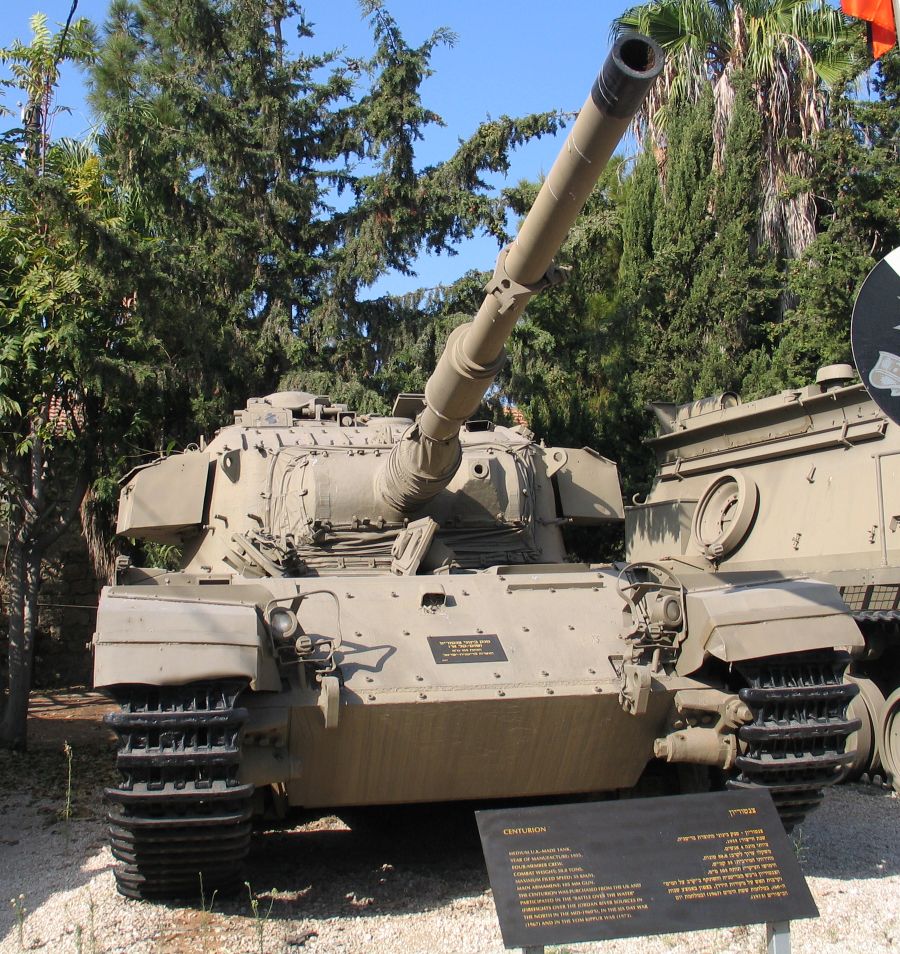
Centuuuuuuuuuuuuuuuuuuuuuuuurioooooooooooooooooooooon!

(via Wikipedia)
Ceeeeeeeeeeeeeeeeeeeeeeeeeeeeeeeeeeeeeeeeeeeeeeeeeeeeeen

(via Wikimedia)
tuuuuuuuuuuuuuuuuuuuuuuuuuuuuuuuuuuuuuuuuuuuuuuuuuuuuuuuuuuuuur

(via Wikimedia)
iiiiiiiiiiiiiiiiiiiiiiiiiiiiiiooooooooooooooooooooooooooooooooooooooooooooon!

(via Wikimedia)

Thursday, December 26, 2013

Turn: America's First Spy Ring looks hella interesting

Saw the commercial for this new show just now and my interest is definitely piqued. I mean, how many TV shows set during the Revolutionary War are there?


From AMC's website:
Based on the book Washington’s Spies written by Alexander Rose, Turn is set in the summer of 1778 and tells the story of New York farmer Abe Woodhull, who bands together with a group of childhood friends to form The Culper Ring, an unlikely group of spies who turn the tide in America’s fight for independence. Turn, from AMC Studios, is written by showrunner Craig Silverstein (Nikita) and executive produced by Barry Josephson (Bones, Enchanted) from Josephson Entertainment. The series stars Jamie Bell as Abraham Woodhull, Kevin McNally as Judge Richard Woodhull, Burn Gorman as Major Hewlett, Angus MacFadyen as Robert Rogers, JJ Feild as Major John Andre, Seth Numrich as Ben Talmadge, Daniel Henshall as Caleb, and Heather Lind as Anna Strong.
I think the only thing I've seen Jamie Bell in was that movie Jumper with Hayden Christiansen (aka Anakin Skywalker/Darth Vader), but he's been in a bunch of other movies. I've never heard of any of the other actors, but then again, how many people had heard of the casts of Mad Men or The Walking Dead before those shows came along? Here's to hoping this doesn't flop like Rubicon did. AMC has had a pretty good track record thus far, so I'm optimistic.

Wednesday, August 21, 2013

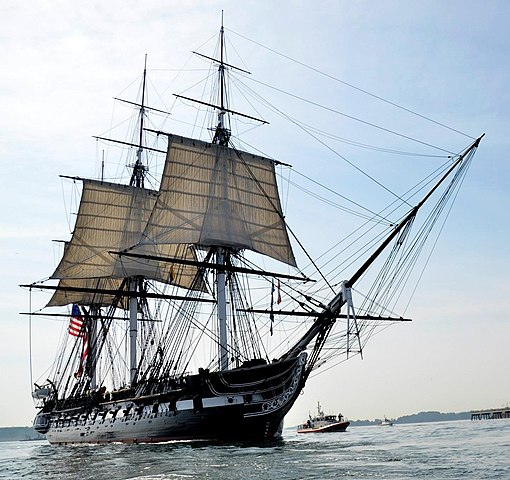
Check out this picture of the USS Constitution's original sail plan

Via Wikipedia.
So, Monday marked the 201st anniversary of the USS Constitution's (Old Ironsides) victory over the HMS Guerriere during the War of 1812. Indeed, it was during this battle that the ship earned her famous nicknamed of 'Old Ironsides' due to her hull withstanding the cannon shots of the Guerriere. Apparently, this was due to American oak trees being more dense than those grown in Europe. So, to mark this occasion, here's the original sail plan for the Constitution.

Credit: National Archives.
Probably my favorite thing about the Constitution is that 215 years after she entered service, the ship is still a commission warship today. Only the HMS Victory beats it and that's the only time a British warship has bested her.

h/t Popular Science.

Thursday, August 1, 2013

The Duke and Duchess of Cambridge naming their son George was beyond predictable, wasn't it?

Old news for sure, but what the hell. When I heard that the future King of the Commonwealth* and his wife had named the future future King** George, I thought it was rather anti-climatic. George is one of the most common first names for princes in the UK, along with Richard, Edward, Henry, William, and James. George is the second most common, after Henry and seeing as how they already have a prince named Henry, George would've been the most obvious. I wonder if there's a reason why the Royal Family has such a limited pool of names? Other than tradition, I mean. Succession-wise, we're looking at a Charles III, a William V, and a George VII. At least we will, provided that the Queen doesn't turn out to be a Highlander and lives forever.


*We can all agree that sounds badass, right?
**Unless he ends up becoming a trans person and then a woman or something.

Thursday, June 13, 2013

Iron Maiden - The Trooper


The Trooper, of course, is based on the famous Charge of the Light Brigade, which itself was forever immortalized by Alfred, Lord Tennyson in his epic poem. Amazing how an absolute clusterf*ck like that gets turned into some sort of celebrated event, yet Pickett's Charge during the Battle of Gettysburg in the American Civil War is infamous as a huge blunder and isn't immortalized.

I just wonder if any wargamers have played this during a Victorian era game? If not, then I am terribly disappointed in all of you. :P

Wednesday, January 30, 2013

I guess you could say that my reading lately has been pretty Sharpe


Wow that was bad. It wasn't punny at all.

Okay, I'll stop now.

As you might be able to guess from the title, I've started reading Bernard Cornwell's excellent Richard Sharpe series of novels, beginning with Sharpe's Tiger.
bookfever.com.

I'm on the 43rd page, but damn it is good. Here's the gist:
In a battery of events that will make a hero out of an illiterate private, a young Richard Sharpe poses as the enemy to bring down a ruthless Indian dictator backed by fearsome French troops.

The year is 1799, and Richard Sharpe is just beginning his military career. An inexperienced young private in His Majesty's service, Sharpe becomes part of an expedition to India to push the ruthless Tippoo of Mysore from his throne and drive out his French allies. To penetrate the Tippoo's city and make contact with a Scottish spy being held prisoner there, Sharpe has to pose as a deserter. Success will make him a sergeant, but failure will turn him over to the Tippoo's brutal executioners — or, worse — his man-eating tigers. Picking his way through an exotic and alien world. Sharpe realizes that one slip will mean disaster. And when the furious British assault on the city finally begins, Sharpe must take up arms against his true comrades to preserve his false identity, risking death at their hands in order to avoid detection and thus to foil the Tippoo's well-set trap.

Saturday, January 12, 2013

Still alive


Sorry for the last of posting, but I've been busy. Met an odd man with a blue 1960s police box and a woman he called his companion and traveled with them for a bit. It was fun until we decided to take in a merry little battle in Ireland and I got some poor bastard's brains splattered all over me thanks to an ill-timed (or well-placed, depending on your disposition) cannonball.

In all seriousness, I was just in one of my slumps and didn't feel like posting anything historical lately. I'll be fixing that soon enough. I found a very interesting book during a visit to a Goodwill: A Monarchy Transformed: Britain 1603-1714 by Mark Kishlansky. It's part of Penguin's History of Britain series and covers the Stuart period, including the English Civil War and the Commonwealth. The prologue really got my attention and lured me in by describing all of the different achievements that occurred during that era, from science to politics to fashion and economics. Short too at 386 pages; 342, if you don't count the index and "further reading" sections.

Friday, November 2, 2012

British Empire, circa 1921

A fairly interesting map showing the empire's territorial holdings in the years between the world wars.

Wikipedia.
What I think is interesting (and amusing) is the size disparity between the UK itself and some of its colonies and dominions. The disparity becomes even bigger when you consider that Africa is the second largest continent and its size was often decreased (while the UK's was increased).

Actually, Belgium has the UK beat when it comes to size difference. The Belgian Congo was so much bigger than the Kingdom that controlled it, it looked like somebody gave Rhode Island control of a territory the size of China.

The Soviet Union, though, holy freaking crap.

Thursday, April 26, 2012

Twenty WWII spitfire fighters discovered in Burma

Holy moly guacamole, this is awesome!

A British farmer spent 15 years and a metric buttload of money to look for the stalwart planes and finally managed to locate them in an underground bunker in Burma. Apparently, the British buried them there near the end of the war both because they were obsolete and to prevent them from falling into the hands of the Japanese. Another thing that's interesting is that the planes were never taken out of the crates they were shipped over in.
...Of course, enthusiasts of WW2 “Warbirds,” military history buffs and action figure collectors are all equally excited about this stunning discovery, especially after learning that yes, the buried planes were still INSIDE their shipping crates, tarred, lubed and sealed up tight.
This find is pretty important because the number of working Spitfires in the world is only 35, so these twenty will go a long way towards ensuring their survival. Spitfires are an important part of not just British history, but world history. These are the planes that helped defend England during the Blitz and fought the forces of Fascism in Europe and Asia. Plus, they're just pretty to look at. Pre-jet engine military aircraft have an elegance and beauty that their successors their lack.

h/t to The Joe Report and The Lair of the Evil DM.

Monday, March 19, 2012

Robert Conroy's 1862

Note: This is a cross-post from my primary blog, Giant-Size Nerd-Thing!.

I'll write a review tomorrow, but suffice to say that this was a pretty good book. The premise is simple: In 1862, a U.S. Navy ship stopped a British mail ship, named the Trent and removed two representatives of the Confederate States of America bound for England and France. Now in real life, it was a debacle that almost brought Britain and the U.S. to war, but diplomacy (and more than a little butt kissing) avoided that fate. In Robert Conroy's book, however, those overtures fail and England goes to war. This is all part of a plan hatched by the Prime Minister of England, Lord Palmerston, to remove the United States as a economic and military rival by ensuring a divided America. What happens is far from what is expected.

Like I said, it was a good book and if you like reading alternative history, then check it out.

Picture via Barnes & Noble.

Tuesday, March 13, 2012

Did you know shrapnel came from a guy named Henry Shrapnel?

Because I didn't until just now. Henry Shrapnel was an officer in the British Army that invented a new type of exploding cannon shell back in 1780s. Nasty weapon, actually - it was designed to explode overhead of an enemy army and rain metal down on them. Thus, the word shrapnel was born. I always thought it was one of those loanwords from a foreign language that was just assimilated into the English vocabulary. Learn something new everyday.

Monday, June 13, 2011

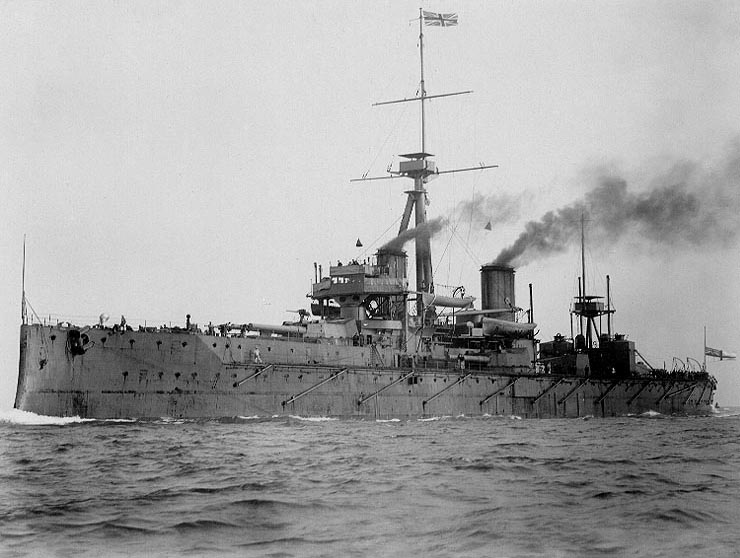
HMS Dreadnought, the ship that literally changed the game

Credit: Wikipedia.
The HMS Dreadnought, lead ship of not only the Dreadnought class, but dreadnoughts themselves. Dreadnoughts were a beast of a ship - larger, heavier and better armed and armored than other ships of the time. In fact, the Dreadnought rendered every battleship of the era obsolete by its mere existence, they became known as pre-dreadnoughts. Launched in 1906, she was probably the most feared ship on the planet, yet never saw serious combat. No joke, the only ship the Dreadnought ever sank was an unfortunate German submarine that it rammed.