Showing posts with label American history. Show all posts

Friday, July 9, 2021

I don't know why I think this is funny

Not "ha ha" funny, but just amusing, but I was at the library the other day and noticed that back in the American history section they had four books - 1774: The Long Year of Revolution by Mary Beth Norton, 1775: A Good Year for a Revolution by Kevin Phillips, 1776 by David McCullough, and 1777: Tipping Point at Saratoga by Dean R. Snow. The fact that four separate people covered a four year period of American history in a sequence independently of one another amused me.

I've developed an interest in American history recently, so these four books will help. I can't tell you exactly why I have this interest, but I think it might be a combination of two things: 1. Right-wingers going on and on about how the "commies", "leftists", or whatever the current boogie man is is trying to "cancel" history or some such nonsense. 2. Realizing that my own knowledge of American history, especially early American history, is spotty. I have a general knowledge of people and events, but I've never much cared about delved into it until now. Given that the right-wing is setting its sights on "patriotic" historical revisionism, I figured I better get to reading before it's too late.

With that in mind, I'm going to start with Norton's book, then work my way forward. I also started reading another book called Autumn of the Black Snake by William Hogeland. The book is about the events that led to the founding of the United States Army, the behind the scenes political maneuvering required for its formation, and its first campaign: an invasion of the Northwest to defeat a coalition of Native American tribes. The Black Snake in the title is a nickname bestowed by those very same natives on the general commanding this new army, "Mad Anthony" Wayne. Should be interesting.

I just hope I can get through all of these books!

Tuesday, January 21, 2014

Grand Watermelon coin note

The Grand Watermelon. No relation to The Great Pumpkin.
(via Wikipedia)
In the 1890s, the United States Treasury Department issued treasury notes under the auspices of the Sherman Silver Purchase Act to individuals selling silver to the Treasury. Back in those days, one of the hot button issues was the use of gold and/or silver to back American currency. Some people favored gold, others silver. Some people even favored both, called bimetalism. The coin notes, as they were called featured the portraits of Union generals and an admiral from the American Civil War, such as George Henry Thomas, James McPherson, George Meade, Philip Sheridan, William Sherman, and U.S. Navy admiral David Farragut. Secretary of War Edwin Stanton, Secretary of State William Seward, and Supreme Court Chief Justice John Marshall.

The notes were issued from 1890 until 1893 when the Silver Purchase Act was repealed during the Grover Cleveland administration as a result of an economic panic that year that threatened to drain the government's gold reserves.

The thousand dollar note was called the "Grand Watermelon" because the zeroes on the reverse look like watermelons.

Thursday, December 26, 2013

Turn: America's First Spy Ring looks hella interesting

Saw the commercial for this new show just now and my interest is definitely piqued. I mean, how many TV shows set during the Revolutionary War are there?


From AMC's website:
Based on the book Washington’s Spies written by Alexander Rose, Turn is set in the summer of 1778 and tells the story of New York farmer Abe Woodhull, who bands together with a group of childhood friends to form The Culper Ring, an unlikely group of spies who turn the tide in America’s fight for independence. Turn, from AMC Studios, is written by showrunner Craig Silverstein (Nikita) and executive produced by Barry Josephson (Bones, Enchanted) from Josephson Entertainment. The series stars Jamie Bell as Abraham Woodhull, Kevin McNally as Judge Richard Woodhull, Burn Gorman as Major Hewlett, Angus MacFadyen as Robert Rogers, JJ Feild as Major John Andre, Seth Numrich as Ben Talmadge, Daniel Henshall as Caleb, and Heather Lind as Anna Strong.
I think the only thing I've seen Jamie Bell in was that movie Jumper with Hayden Christiansen (aka Anakin Skywalker/Darth Vader), but he's been in a bunch of other movies. I've never heard of any of the other actors, but then again, how many people had heard of the casts of Mad Men or The Walking Dead before those shows came along? Here's to hoping this doesn't flop like Rubicon did. AMC has had a pretty good track record thus far, so I'm optimistic.

Wednesday, August 21, 2013

Check out this picture of the USS Constitution's original sail plan

Via Wikipedia.
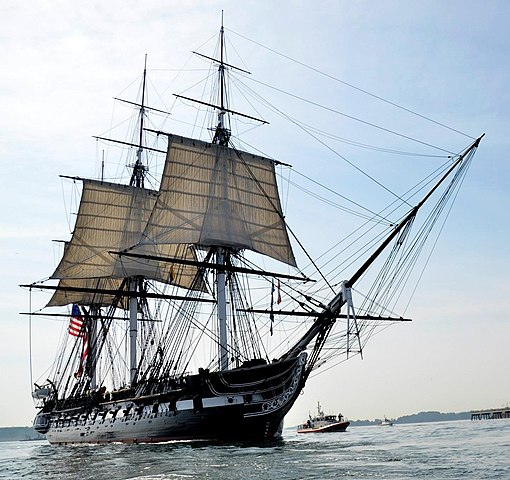
So, Monday marked the 201st anniversary of the USS Constitution's (Old Ironsides) victory over the HMS Guerriere during the War of 1812. Indeed, it was during this battle that the ship earned her famous nicknamed of 'Old Ironsides' due to her hull withstanding the cannon shots of the Guerriere. Apparently, this was due to American oak trees being more dense than those grown in Europe. So, to mark this occasion, here's the original sail plan for the Constitution.

Credit: National Archives.
Probably my favorite thing about the Constitution is that 215 years after she entered service, the ship is still a commission warship today. Only the HMS Victory beats it and that's the only time a British warship has bested her.

h/t Popular Science.

Wednesday, November 7, 2012

Damn, Lincoln looks like a good movie


Tommy Lee Jones looks weird with that hair, but any movie with him in it tends to be good. Daniel Day-Lewis might be the greatest living actor today and certainly one of the greatest ever. The movie won't focus on Lincoln's entire life or presidency, but the last months of his life. Who knows, if the movie is a big enough success, maybe Spielberg will make prequels covering the rest of Lincoln's life.

Wednesday, July 4, 2012

Happy Independence Day!

Though, I'm not entirely sure why they made a holiday in honor of that movie. Personally, I thought it was sub-par.

Monday, March 19, 2012

Robert Conroy's 1862

Note: This is a cross-post from my primary blog, Giant-Size Nerd-Thing!.

I'll write a review tomorrow, but suffice to say that this was a pretty good book. The premise is simple: In 1862, a U.S. Navy ship stopped a British mail ship, named the Trent and removed two representatives of the Confederate States of America bound for England and France. Now in real life, it was a debacle that almost brought Britain and the U.S. to war, but diplomacy (and more than a little butt kissing) avoided that fate. In Robert Conroy's book, however, those overtures fail and England goes to war. This is all part of a plan hatched by the Prime Minister of England, Lord Palmerston, to remove the United States as a economic and military rival by ensuring a divided America. What happens is far from what is expected.

Like I said, it was a good book and if you like reading alternative history, then check it out.

Picture via Barnes & Noble.

Tuesday, November 15, 2011

The War Over Stolen Smoked Meat

Ladies and gentlemen, The Crazy Snake Rebellion.
The Crazy Snake Rebellion, also known as the Smoked Meat Rebellion or Crazy Snake's War, was an incident in 1909 that at times was viewed as a war between the Creek people and American settlers. It should not be confused with an earlier, bloodless, conflict in 1901 involving much of the same people. The conflict consisted of only two minor skirmishes, and the first was actually a struggle between a group of marginalized African Americans and a posse formed to punish the alleged robbery of a piece of smoked meat.
Seriously? That had to have been a damn fine piece of meat in order to instigate an armed conflict. What was it, Holy Bacon? Also, "Smoked Meat Rebellion" is one of the best names for a conflict since the War of Jenkin's Ear in 1739.

Monday, June 13, 2011

The Flying Squadron of the Spanish-American War

Credit: Murat Halstead/Wikipedia.
The Flying Squadron was the name given to a group of U.S. Navy warships that fought the Spanish fleet around Cuba during the Spanish-American War and operated in the Gulf, Atlantic and Indies. The squadron consisted of two battleships (Texas and Massachusetts), two protected cruisers (Minneapolis and Columbia, an armored cruiser (Brooklyn) and several other ships. The Squadron was commanded by Commodore Winfield Schley.

John Paul Jones and his return home

Credit: Wikipedia.
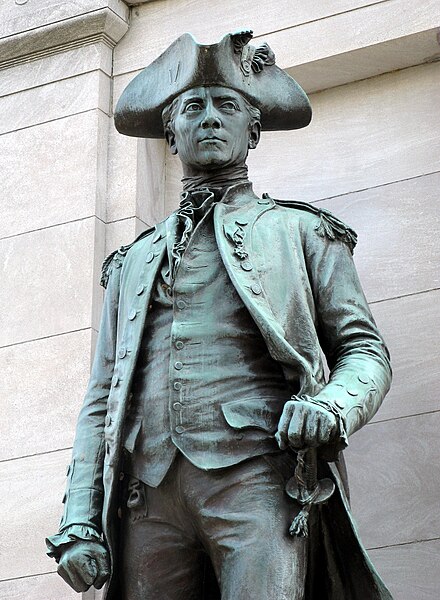
John Paul Jones was a famous naval officer who commanded the fledgling Continental Navy during the American Revolution and is regarded as the Father of the United States Navy. Jones is an interesting man and ballsy as all hell. During the war, he lead raids not only against English shipping, but two raids of British Isles themselves - first at Whitehaven, where he planned to burn all the ships in the harbor and anything else he could, followed by a raid against an Earl's estate on St. Mary's Isle, where he planned to kidnap and hold the Earl for ransom! Like I said, this guy was ballsy. He also participated in an attempted invasion of England by a combined Spanish and French force in 1779 and with several French ships under his nominal command, attempted to create a diversion to lure the Royal Navy's Channel Fleet away. The invasion failed, but in the subsequent battle between his ship, the Bon Homme Richard and the HMS Serapis, the legend of his famously proclaiming "I have not yet begun to fight!" was created. There is some doubt as to his saying that, but he did say "I may sink, but I'll be damned if I strike" in response to the captain of the Serapis asking for his surrender.

Did I mention that at the time, Jone's ship was sinking? And just to top it off, he won that battle and took the Serapis as his own. After the war, he decided to stay in Europe, first living in Paris, then moving to Russia and taking a job in their navy. He eventually left after political backstabbing a smear campaign directed against him by jealous Russian officers and returned to Paris, where he died on July 18, 1792. He was buried at St. Louis Cemetary, which belonged to the Royal Family of France. Unfortunately, the French Revolution hit not long after, the Revolutionary government that took over sold the land and I guess in the chaos, the everybody forgot "oh hey, there are bodies buried here, somebody might want to note that."